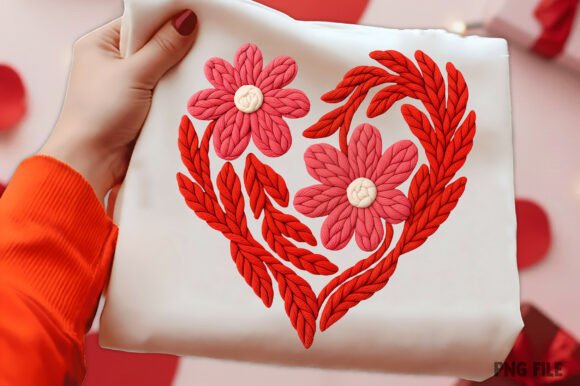
Yarn Crochet Valentine’s Day PNG: A Practical Asset for Creative Workflows
When planning seasonal creative projects—especially around Valentine’s Day—having high-quality, production-ready assets saves time, reduces friction, and strengthens output consistency. The Yarn Crochet Valentine’s Day PNG fits precisely into that role: a digitally delivered, transparent-background design optimized for real-world use across physical and digital product pipelines.
What It Is—and Where It Fits in Your Process
This isn’t decorative inspiration or a low-res sketch—it’s a finalized, 300 dpi, 4000×4000 pixel PNG file with a solid-color distressed effect and full transparency. That means it’s built for immediate integration—not editing from scratch, not scaling up at the risk of pixelation, not wrestling with background removal. It arrives ready to drop into your workflow at the point where asset selection meets execution.
For example, if you’re preparing sublimation transfers for a February product launch, this file sits between design finalization and production prep. You don’t need to source textures, layer yarn effects manually, or adjust color balance for print fidelity—you import it, resize as needed (it scales cleanly in Photoshop, Affinity Designer, Cricut Design Space, or Canva), and move forward.
How It Supports Planning, Execution, and Consistency
Pre-project, it informs scope and feasibility. Knowing you have a professionally rendered, resolution-robust element helps estimate timelines accurately—no last-minute raster fixes or vendor delays due to file limitations. During execution, it functions as a consistent visual anchor: whether applied to a greeting card layout, a T-shirt mockup, or wall art framing, the distressed yarn texture reads cohesively because it’s built on uniform contrast, edge clarity, and intentional grain.
Post-delivery, it supports reuse and versioning. Because it’s a single-layer, transparent PNG, you can apply it across multiple colorways (e.g., rose gold foil overlay, deep burgundy screen print) without reworking base elements. That maintains brand or seasonal continuity across platforms—Instagram posts, Etsy listings, printed brochures—without redundant labor.
Compatibility Across Tools and Platforms
The Yarn Crochet Valentine’s Day PNG works predictably in environments where transparency and resolution matter most:
- Sublimation workflows: Import directly into Sawgrass Print Manager or ChromaRIP; no alpha-channel cleanup needed.
- DTG and screen printing: Use in Illustrator (placed as embedded raster) or Photoshop (Smart Object) for clean halftone separation.
- Craft cutting software: Works in Cricut Design Space and Silhouette Studio at native size—no trace errors or anti-aliasing artifacts.
- Digital publishing: Embeds cleanly in Canva, Adobe InDesign, or Notion docs without compression loss or background bleed.
No plugin, conversion, or intermediary step is required. If your tool accepts PNGs—and nearly all do—this file integrates without configuration.
Practical Implementation Tips
Start with purpose, not placement. Ask: “What outcome does this asset serve?” A Valentine’s Day card line? Then test the PNG at 3×5”, 5×7”, and A6 sizes in your layout software to confirm legibility and texture fidelity. Running a small-batch apparel line? Place it on a grayscale fabric swatch preview first—distressed effects behave differently on polyester vs. cotton-blend substrates.
Organize files systematically. Save versions with clear naming: Yarn_Crochet_Valentine_PNG_v1_transparent_4000x4000_300dpi.png. Avoid renaming to generic terms like “valentine1.png”—that creates friction during bulk exports or team handoffs.
Resizing is straightforward but not automatic. While the file scales well, avoid stretching beyond 200% in vector-based tools unless you’ve converted it to a smart object or embedded it non-destructively. For large-format wall decor (e.g., 24×36” prints), verify sharpness at 100% zoom before sending to print—most RIP software will flag interpolation issues early.
Integration With Broader Creative Systems
This PNG doesn’t exist in isolation. It gains value when aligned with complementary resources:
- Color systems: Pair it with a defined palette (e.g., Pantone 18-1943 TCX “Rose Brown” + 18-1663 TCX “Coral Red”) to ensure cohesive merchandising.
- Typography pairings: Use it alongside serif headings (e.g., Playfair Display) and soft sans-serif body text (e.g., Lato) to reinforce handmade warmth without visual clutter.
- Photography style: If shooting product flat lays, match lighting temperature (2700K–3200K) to enhance the distressed yarn’s tactile feel.
- Brand guidelines: Document usage rules—minimum clear space, prohibited scaling thresholds, acceptable background colors—to maintain recognition across touchpoints.
That level of integration turns a single asset into a repeatable component—not just decoration, but part of your operational vocabulary.
Quality Control and Long-Term Usability
Because it’s delivered at 300 dpi and 4000×4000 pixels, quality control starts at import. Open the file in your preferred editor and check three things:
- Transparency is fully intact (no faint gray edges or semi-opaque fringes).
- Distressed texture retains definition at 50% zoom—no blurring or oversmoothing.
- Color values are stable (e.g., solid #C97F7F for rust-red yarn tone, not a gradient or dithered fill).
If those hold, the file will perform consistently across devices, outputs, and future projects—even two years from now. Unlike JPEGs or compressed web graphics, this PNG preserves fidelity through repeated saves and platform migrations.
Real-World Workflow Examples
A small-batch stationery seller: Uses the Yarn Crochet Valentine’s Day PNG as the central motif on 100 folded cards. Imports into Illustrator, applies a subtle emboss effect, exports as PDF/X-4 for local print—total prep time under 20 minutes.
An educator creating classroom valentines: Places the PNG over student-drawn hearts in Google Slides, resizes to fit printable 2×3” labels, exports as PNG batch for sticker printer—no design software required.
A freelance marketer building a client’s seasonal campaign: Drops the file into Figma as a reusable component, builds three social templates (Instagram post, Story, Pinterest pin), then swaps only copy and CTAs—asset stays locked and consistent.
In each case, the PNG acts as infrastructure—not the focus, but the reliable foundation enabling speed, accuracy, and repeatability.
Final Considerations Before Use
Remember: this is a digital-only file. No physical item ships. That means your responsibility begins at download—back it up (local + cloud), verify checksums if provided, and store it in a project-agnostic assets folder for cross-client reuse. Also, review license terms: standard commercial use is included, but resale as standalone clip art or inclusion in editable template marketplaces may require extended rights.
If you work with teams, share the file with context—not just the link. Note its dimensions, DPI, and intended use cases in your shared drive description. That prevents misapplication (e.g., using it for web banners where 72 dpi would suffice—and waste bandwidth).
Follow to discover more artwork like this—curated for practicality, tested for compatibility, and built to integrate, not interrupt.