Vintage Sewing Junk Journal Page
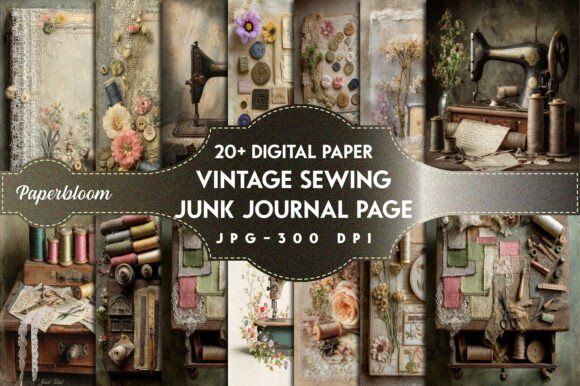
A Vintage Sewing Junk Journal Page is a digital paper design intended for crafters who work with printable or layered paper-based projects. It features hand-drawn or carefully curated vintage sewing motifs—such as antique thimbles, spools of thread, fabric swatches, needle cases, and handwritten script—arranged in an aesthetically cohesive 12×12 inch layout. Designed at 300 DPI and 3600×3600 pixels, each page is delivered as a high-resolution JPG file, optimized for clarity when printed or layered digitally.
This type of digital paper serves a functional and stylistic role: it provides a ready-made background or focal layer that evokes nostalgia without requiring the user to source, scan, or composite vintage elements themselves. It is commonly used in junk journaling—the art of assembling tactile, themed journals from mixed ephemera—as well as scrapbooking, card making, planner decoration, and mixed media collage.
Why Consider a Vintage Sewing Junk Journal Page?
Crafters often seek digital papers that align with a specific aesthetic while minimizing prep time. A Vintage Sewing Junk Journal Page meets that need for users drawn to domestic history, textile traditions, or mid-century visual language. Its appeal lies not only in appearance but in practical utility: it offers consistency across multiple pages, supports thematic continuity in multi-page projects, and eliminates the need to license or edit individual clipart elements.
People exploring this resource may be evaluating whether it fits into an existing workflow—such as building a printable planner with seasonal themes—or assessing how it compares to other vintage-themed digital papers. Others may be new to digital crafting and weighing the learning curve involved in using downloadable assets versus physical ephemera.
Benefits and Realistic Expectations
One clear benefit is efficiency. With 20 unique pages included, users gain variety without repeating layouts—a helpful feature when assembling longer journals or themed collections. The 300 DPI resolution ensures sharp output when printed on standard craft paper or photo stock, supporting both inkjet and laser printers.
However, expectations should align with the format. As JPG files, these pages are flat raster images—not editable vector layers. Users cannot isolate individual elements (e.g., move just the thimble without the background) unless they use image-editing software with selection tools. There is no transparency, so layering over colored or patterned backgrounds requires careful contrast planning.
The design style also assumes a preference for warm, muted palettes and handcrafted texture. Those working with bold modern typography or minimalist layouts may find the ornate details visually busy or difficult to balance. Likewise, because the pages are precomposed, customization options are limited to scaling, rotation, and placement—not rearrangement of components.
When This Resource Fits Well
A Vintage Sewing Junk Journal Page is especially useful in contexts where authenticity of era and materiality matters. For example:
- Creating a gift journal for someone who sews or collects vintage textiles;
- Designing printable workshop materials for a sewing history class;
- Building a themed memory-keeping system centered on family heirlooms or domestic skills;
- Producing greeting cards or invitations for a bridal shower with a “stitch-and-sew” motif;
- Supporting analog-digital hybrid workflows—scanning handwritten notes onto printed journal pages.
In each case, the consistent visual language helps unify disparate elements. Because the designs avoid photorealism in favor of stylized illustration, they retain flexibility across scales and applications—from small journal inserts to full-page spreads.
When Alternatives May Be More Suitable
Users with specific technical needs may find alternatives preferable. For instance:
- If you require transparent PNGs for easy layering in design software like Canva or Procreate, a JPG-only set limits flexibility;
- If your project calls for monochrome or line-art versions (for coloring books or embroidery patterns), this set’s full-color, textured approach may not serve that purpose;
- If you prefer modular design—where individual sewing icons can be resized and repositioned freely—standalone clipart packs or SVG bundles offer more control;
- If historical accuracy is essential (e.g., representing 19th-century sewing tools rather than mid-20th-century aesthetics), verifying the design references against archival sources becomes necessary.
Additionally, those already invested in physical ephemera—like actual lace trim, old fabric scraps, or vintage labels—may find digital papers less satisfying for tactile-heavy projects. In such cases, scanning personal items or sourcing physical vintage papers could better support the desired sensory experience.
Making a Practical Decision
To determine whether a Vintage Sewing Junk Journal Page suits your goals, consider three questions:
- What is the primary medium of your project? If most output will be printed and assembled by hand, high-resolution JPGs are sufficient. If you’re designing for screen-only use (e.g., digital planners in GoodNotes), ensure the resolution matches your device’s display scale.
- How much control do you need over composition? If you frequently adjust spacing, color balance, or element hierarchy, editable formats (PNG, SVG, or layered PSD) may be more efficient long-term—even if they cost more or require additional software.
- Does the visual tone match your audience or intent? A sewing-themed journal for beginners might benefit from clearer iconography and simpler backgrounds; one for collectors may prioritize nuanced textures and subtle aging effects.
Also note that digital papers function best as part of a broader toolkit—not standalone solutions. Pairing them with coordinating fonts, complementary color palettes, or related printable templates often yields stronger results than relying on the pages alone.
Finally, review licensing terms before purchase. While most digital papers permit personal and small-batch commercial use (e.g., selling handmade journals), some restrict resale of unaltered pages or use in digital templates for resale. Clarifying permitted uses early avoids misalignment later.