Christmas Peace on Earth Sublimation
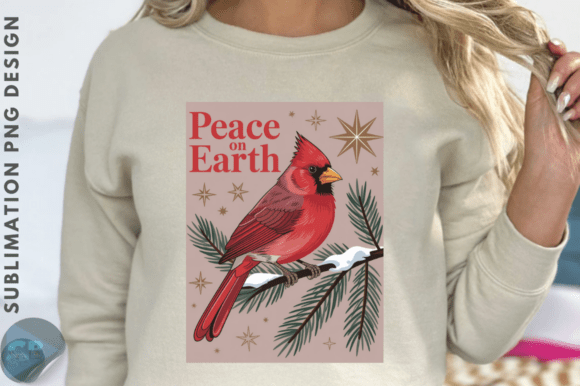
Christmas Peace on Earth Sublimation is a ready-to-use digital asset designed for heat-transfer applications—primarily on apparel, home décor, mugs, ornaments, and other polyester-coated or sublimation-friendly surfaces. Unlike editable vector files, this specific offering delivers a single high-resolution PNG: 2500 x 2500 pixels at 300 dpi, with a transparent background and no layers or text-editing capability. Its purpose isn’t customization in the traditional design sense—it’s precision deployment. You acquire it, prepare your substrate, apply heat and pressure, and embed the artwork permanently. That simplicity is intentional—and powerful—if you understand where it fits in your creative or commercial workflow.
Where It Fits: Before, During, and After Your Project
Before launching a holiday product line, many creators spend weeks sourcing fonts, adjusting color palettes, testing layout proportions, or troubleshooting raster-to-vector conversions. With Christmas Peace on Earth Sublimation, that phase shrinks significantly. You’re not starting from scratch—you’re starting from a finished, production-ready composition. The design already balances typographic hierarchy (e.g., “Peace on Earth” as focal point), visual weight (dove motifs, celestial elements, or watercolor texture), and technical readiness (crisp edges, alpha transparency, RGB color mode optimized for sublimation inks). That means less time prepping files and more time validating mockups, ordering test prints, or refining packaging and messaging.
During production, consistency matters. If you’re printing 50 mugs and 200 t-shirts across multiple batches, using the same PNG eliminates version drift. There’s no risk of accidentally swapping a draft file, misaligning layers, or exporting at the wrong resolution—because there’s only one file, and it’s locked in. This supports quality control: every item carries identical contrast, saturation, and detail density. For small business owners managing seasonal inventory, that reliability reduces rework, customer service inquiries about print variation, and wasted materials.
After fulfillment, the design continues to serve—not as a file, but as a brand signal. A “Peace on Earth” mug placed on a teacher’s desk, a farmhouse-style ornament hung in a counselor’s office, or a boho-inspired tee worn at a community event all reinforce shared values without requiring explanation. The artwork functions as quiet, aesthetic alignment—connecting product use to intention. That resonance extends beyond aesthetics into marketing: customers photograph these items organically, tag brands, and share context-rich moments. You don’t need to script the narrative—the design carries enough emotional clarity to support it.
Integration Across Tools and Platforms
This PNG integrates cleanly with common sublimation workflows. It imports without issue into Sawgrass Print Manager, ChromaRIP, or Roland VersaWorks—no conversion needed. Because it’s RGB and 300 dpi, it aligns with standard sublimation printer profiles. No resizing is required for most common substrates: a 2500 x 2500 px canvas scales accurately to fit an 11" x 14" press mat or centers perfectly on a 12 oz ceramic mug blank when sized to ~2800 px wide in your RIP software.
For designers using Canva, Adobe Express, or Cricut Design Space, the transparent background allows quick compositing—overlaying the Peace on Earth artwork onto mockup templates, social media banners, or email headers. While you can’t edit the text or illustration directly, pairing it with complementary elements (e.g., a handwritten “Season’s Greetings” banner beneath it, or a subtle snowflake border) adds variety without compromising the core asset’s integrity.
It also works within broader content systems. Educators embedding it into printable holiday lesson plans benefit from its clean lines and thematic clarity—students recognize symbols like doves or olive branches instantly. Bloggers writing about mindful holiday traditions can use it as a featured image that conveys tone before the first sentence loads. And nonprofit teams building awareness campaigns find its versatility useful: the same file appears on tote bags handed out at events, in digital ads, and as part of downloadable resource kits—all maintaining visual continuity.
Practical Implementation Tips
- Verify substrate compatibility first. Not all blanks accept sublimation equally. Polyester fabric blends (65%+), coated ceramics, aluminum, and certain polymer-coated wood perform best. Test one print before scaling.
- Use mirrored export settings. Most RIP software requires horizontal mirroring for sublimation transfers. Confirm this is enabled—especially if importing into third-party tools that don’t auto-mirror.
- Batch prep saves time. Load multiple copies of the PNG into your queue, then adjust sizing per item type (e.g., 7.5" width for tumblers, 10" for pillows) rather than opening and resizing each time.
- Store with metadata. Rename the file clearly (e.g., “peace-on-earth-christmas-sublimation-2500px”) and add tags like “holiday,” “dove,” “vintage,” or “watercolor” in your digital asset manager. That speeds retrieval during future seasonal planning.
- Pair intentionally—not repetitively. Use the same Peace on Earth design across products, but vary presentation: distressed texture on a rustic apron, soft watercolor bleed on a linen tea towel, crisp typography on a glass ornament. Context shapes perception more than the asset itself.
Long-Term Usability and Quality Control
This isn’t disposable clipart. Because it’s delivered at true print resolution (2500 x 2500 px @ 300 dpi), it remains viable across evolving output standards. Even if you upgrade to a higher-DPI printer next year, the file retains headroom—you won’t need to resample or upscale. That supports long-term brand consistency: the same “Peace on Earth” motif appears on your 2024 holiday collection and your 2027 limited reissue, visually anchored and technically sound.
Quality control starts with file hygiene. Since the PNG is not editable, avoid opening it in programs that might alter embedded color profiles (e.g., older versions of MS Paint or basic photo editors). Stick to professional RIP software or trusted design platforms for placement and scaling. Also, calibrate your monitor and printer regularly—sublimation results depend heavily on accurate RGB-to-print translation, especially with nuanced palettes like vintage sepia, muted pastels, or layered watercolor washes.
Finally, consider usage rhythm. Christmas Peace on Earth Sublimation isn’t just for December. Its themes translate to broader contexts: peace education units in February, interfaith dialogue resources in spring, or community-building initiatives in fall. Keeping it organized and accessible means you’re never scrambling for a meaningful, production-ready graphic when timing matters most.
Real-World Workflow Example
A small-batch ceramicist preparing for a local holiday market downloads Christmas Peace on Earth Sublimation Monday morning. By noon, she’s imported it into her RIP software, adjusted size for 12 oz mugs and 4x6 coasters, and sent test prints to her heat press. Tuesday: she photographs three variations—matte black mug, cream ceramic coaster, brushed gold ornament—and uploads them to her Shopify store with cohesive product descriptions centered on “intentional celebration.” Wednesday: she shares one image on Instagram with a caption about choosing calm amid seasonal noise—not promoting the design, but inviting reflection. The file didn’t replace her voice or vision. It accelerated execution so she could focus on what mattered most: connection, craft, and clarity.